LAURY FALTER PHOTOGRAPHY
Seeing the World, Through the Eyes of My Lens


Molting
In early summer buffalo wander through Yellowstone looking half-undone, their winter coats hanging off them in ragged, sun-bleached sheets. It is not a graceful process. They rub against trees and roll in the dust, and the wind carries tufts of old fur across the meadow like something being let go. Watching them, I kept thinking how rarely we see a creature in the middle of becoming something, with neither the old self nor the new one finished yet. There’s a quiet dignity in that unfinished state, in shedding what once kept you alive because the season has changed and you no longer need it.

A Mano
In a corner window in Ybor City, a man bends over his workbench while the street goes on without him. Scraps of tobacco leaf drift around his chair like fallen leaves after a storm, the leftovers of a craft that has been practiced in this neighborhood for well over a century. Ybor was once the cigar capital of the world, where workers at long tables listened to a lector reading newspapers and novels aloud to pass the hours. Today the reader is gone, replaced by a pair of earbuds, but the motion of the hands is the same: stretch, trim, roll, press. There’s something quietly defiant about it, one person in a window keeping the old craft alive, slowly and by hand, while progress rolls past outside.

What We Leave Behind
On the rim of the Grand Canyon, a long-dead tree still stands, but it has not stopped speaking. Wind and sun have stripped it to the grain, twisting the wood into currents that look almost liquid, as if the trunk were still flowing upward toward the living branches behind it. Carved into its surface are names and initials left by people who passed through and wanted to be remembered. Most of them are already fading, softened by the same weather that shaped the wood. The tree is outlasting every one of them. It stands as a quiet reminder that we are visitors here, and the marks we make are small against the patience of something that took centuries to grow and is taking centuries more to disappear.

Knowing the Way Home by Heart
In Mykonos, Greece the streets were never meant to lead you anywhere. The story goes that they were laid out as a maze to trap the pirates who came ashore, turning them back on themselves until they gave up and sailed away for good. Today the alleys are quiet and washed in white, each stone outlined by hand as if someone wanted every path traced and remembered. Staircases climb toward peaceful homes, and at the end of this lane a tiny chapel waits with its bell. Getting lost here no longer feels like a threat. It feels like an invitation to wander slowly, the way the islanders do, until these streets start to feel like home.

Who Is Watching Whom
Up close, it’s hard to look away from a face like this. The heavy-lidded eyes, the creased brow, and the long, weathered stillness all suggest someone lost in thought. The name orangutan comes from Malay and is usually translated as “person of the forest,” and in a moment like this the name feels exactly right. There’s no performance in the expression, just a quiet patience that seems older than us. It’s easy to imagine he’s thinking about something far away, maybe the canopy his kind has lived in for millions of years, now disappearing faster than they can adapt. Looking into a face this familiar, it’s hard not to wonder who is really watching whom.

Still Here
They lay together in the grass as if the whole valley belonged to them, and in a way it does. Their winter coats were coming loose in heavy patches, and they didn’t seem bothered by much of anything, least of all me. The one in front lifted his head just long enough to meet my eyes, steady and unhurried, then went back to resting. A little over a century ago, only a couple dozen wild bison were left in Yellowstone. Now herds like this one rest in the open as though nothing ever threatened them. There’s a quiet triumph in that stillness. Survival doesn’t always look like a fight. Sometimes it looks like lying down in the sun, together, with nowhere else you need to be.
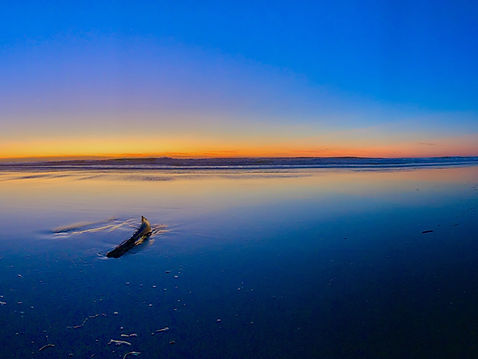
Everything Returns to the Sea
The tide had just pulled back, leaving the sand so smooth and wet that it held the whole sky: the last orange band of sunset, then the deepening blue rising above it. Alone in the middle of all that stillness lay one small frown the ocean had carried in and left behind, its thin edge catching the fading light like a sail. It had traveled who knows how far to end up here, and in a few minutes the next wave would likely take it back. That’s what made the moment feel so tender. Nothing on this beach was meant to stay, not the light, not the reflection, and not me. For a few minutes, though, the sea and the sky held perfectly still, and everything was exactly where it belonged.

Hooves
Below the steam of Yellowstone's Grand Prismatic Spring, the runoff spreads across the ground in bands of rust, gold, and amber, colors made by heat-loving microbes that thrive where almost nothing else can. Pressed into that fragile surface are hoof prints, dozens of them, left by animals that crossed while no one was watching. Visitors stay on the boardwalk, and for good reason: the ground here can be a thin crust over scalding water, and people have lost their lives by stepping off the path. The animals took their chances and passed through anyway, unhurried. Their tracks are a reminder that this landscape was theirs long before the boardwalks, and we are only guests allowed to look.

Kinship
Held up to the light, a single leaf reveals what it usually keeps hidden: a network of veins branching out from the center, then branching again and again until the finest threads reach every corner. It’s the same pattern found in rivers seen from above, in the roots beneath our feet, and in the blood vessels under our own skin. Life seems to have settled on one design and repeated it everywhere. Looking closely, it’s hard not to feel a sense of kinship. This leaf is quietly turning sunlight into the air we breathe, and we breathe back what it needs. We aren’t separate from it. We were never separate from any of it. We are all branches of the same living thing, carrying light to one another.

For Jenny
Jenny Lake in the Grand Tetons is named for Jenny Leigh, a Shoshone woman married to the mountain man and guide Richard “Beaver Dick” Leigh. In 1872, after the couple helped guide a government survey through the valley, the expedition named this lake after her and a neighboring lake after him, so the two would rest side by side for as long as the mountains stand. Only four years later, Jenny and all six of their children died of smallpox. Richard survived them and lived on in the valley that still carries both their names. On the shore, a couple sits close together, looking out at the same water and the same peaks. They may not know the story, but they’re living a quiet version of it: two people, a beautiful place, and a moment that feels like it could last forever.

Keeping the Songs Alive
Captain Tony’s Saloon in Key West, Florida doesn’t so much have a ceiling as a collection of everyone who’s ever passed through. Dollar bills, business cards, and license plates from states and decades long gone are layered so thickly overhead that the room seems held together by other people’s memories. Hemingway drank here when the place was the original Sloppy Joe’s, and a young Jimmy Buffett once played for tips in this room. Below all that history, a man sits on a wooden stool in flip-flops, guitar on his knee, with a drink waiting on the stool beside him. He isn’t famous (yet), and he doesn’t need to be. Every afternoon someone comes to sit in this spot and keep the songs going, so that the next stranger who walks in off Greene Street feels like they’ve found a place where they belong.

Evening Ritual
In San Diego, the sunset is something people make time for. As the light starts to go, they drift down to the water in ones and twos, small figures at the edge of the sand, all facing the same direction as if answering the same quiet call. The tide pulls back and leaves the beach shining like glass, holding the sky in gold near the horizon and violet near my feet. For a few minutes, everything slows down. Nobody is in a hurry, and nobody needs to say anything. It happens every evening, and somehow it never becomes ordinary. Maybe that’s the gift of living by the ocean: being reminded, day after day, that endings can be beautiful too.

Ward
On a ferry crossing the waters of Greece with some of the most beautiful scenery sliding past the windows, she has fallen asleep on his shoulder. He doesn’t move. He sits upright, steady, his eyes fixed on me as I raised my camera, steady and a little wary, as if to say he was keeping track of everything around her, including me. Around them, other passengers come and go, but she can rest because they are together in this world. She can let go because she knows he’ll hold still. He holds still because that’s what love has come to mean: not grand gestures, but a shoulder offered without a word, for as long as it’s needed.

The Refuge
I ducked into the Austrian church only to escape a sudden rainstorm, expecting nothing more than a dry place to wait. In a quiet alcove, under a single small light, I saw her: Mary holding her son’s lifeless body. The alcove around them was shaped by hand long ago, and it has grown so old that its arch now leans slightly askew, as if it had spent centuries bending closer to the grief it was built to shelter. Outside, the rain kept falling on Salzburg’s rooftops. Inside, there was only this stillness, and a grief so old and so human that it needed no translation. For generations, people have come to this spot in their own storms, the private kind that don’t pass in an afternoon, and asked her to pray for them. I had come in looking for shelter from the weather. I left feeling that I’d found another kind of shelter, the kind that comes from realizing that sorrow, too, has been carried before. Some refuges you find by accident, and they stay with you long after the weather clears.

Outlasting Time
Nearly two thousand years ago, Vesuvius buried Pompeii, and these jars were sealed away in ash. By every expectation, they should have been lost. Instead, they survived. They were uncovered, cleaned, labeled by hand, and given a final resting place in Pompeii. Each one was shaped by a potter whose name we’ll never know, then filled with wine, olive oil, or precious spices, or entrusted with the ashes of someone dearly loved. Cracked and chipped as they are, they still carry the fingerprints of daily life in a city that once laughed, traded, cooked, and grieved. The eruption ended Pompeii, but it couldn’t erase it. These quiet vessels are proof that ordinary lives can outlast even catastrophe, and they’re still here to tell their story.

Still Standing
Beneath the live oaks and Spanish moss on the McLeod Plantation near Charleston, South Carolina stands a small wooden cabin, held upright by timber braces. It’s a single room, about the size of a garden shed, and it was home to enslaved people. Whole families lived inside these walls. They slept, cooked, raised children, and mourned here after long days of forced labor on land that was never theirs. Most of their names were never written down, and their stories were rarely recorded by the people who claimed to own them. The braces holding the cabin up today are an act of preservation, a decision not to let it quietly collapse and disappear. The beauty of the trees around it can’t soften what happened here, and it shouldn’t. Some places are kept standing so that we remember the people who lived here, and so that we honor them.

The Last Dance of the Day
At golden hour, the old wooden pier stands with its legs in the surf, catching the last of the light. It’s hard to imagine now, but when it opened as Pickering’s Pleasure Pier in the summer of 1927, a grand ballroom with a towered roof rose at its far end, and couples danced above the waves on a cork-cushioned floor. The music didn’t last long. Within about three months, the ballroom and carnival had closed. After years of legal battles, the ballroom was torn down, and the pier was rebuilt and reopened in 1936 as San Diego's Crystal Pier. Still, the ocean remembers. On the lowest tides, the old pilings that once held up the dance floor sometimes appear again, like footprints left behind by a party that ended almost a century ago. The waves keep rolling in, and the pier keeps standing, holding its own quiet memory of music over the water.

Five Centuries Deep
Five hundred years ago, the day in Montepulciano, Italy began here. Before the sun cleared the hills, women climbed to the square with their jugs and buckets, and the iron pulley above the well creaked with the first water of the morning. This was where news traveled: a birth in one family, a fever in another, a betrothal, a harvest, a death. Children waited at their mothers’ skirts, merchants paused on their way to market, and neighbors who had argued the night before met again over the same cool stone. Above them, the Medici lions and the town’s griffins kept watch, but life itself happened below, in the quiet ritual of drawing water together. The buckets are gone now, and the square is still, yet the stone remains worn smooth by all those hands, as if it still remembers every morning it was needed.